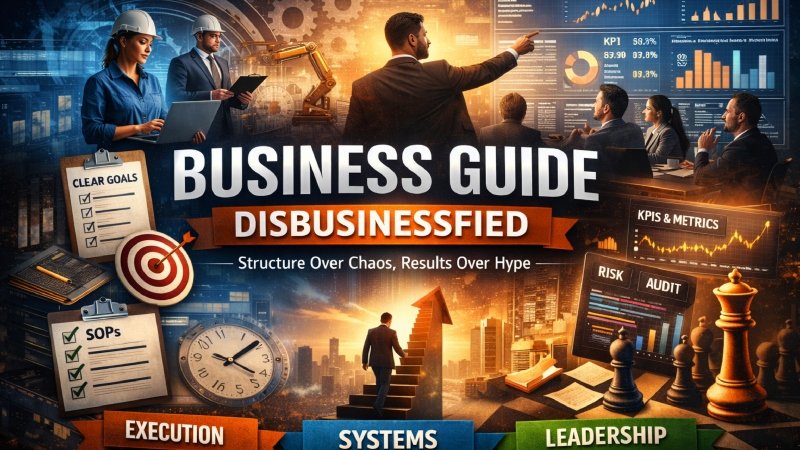
In a market driven by speed, data, and relentless competition, American businesses face a simple problem. There is too much noise and not enough structure. Leaders are flooded with strategies, tools, and opinions. Teams are buried in meetings, metrics, and shifting priorities. The result is confusion disguised as activity. This is where business guide disbusinessfied changes the equation.
This framework strips business down to disciplined execution, measurable systems, and clear communication. It removes ego, guesswork, and complexity. It replaces them with process, ownership, and repeatable performance. For individual professionals and technical teams across the United States, this approach offers something rare.
This article delivers a complete, competitor-proof breakdown designed to lead the search results and provide real value. No jargon. No fluff. Just structured insight.
What Is Business Guide Disbusinessfied and Why It Matters Today
At its core, business guide disbusinessfied is a disciplined operational philosophy. It focuses on structured execution over motivational hype. It builds sustainable results through measurable routines. In today’s U.S. business climate, complexity is expensive. Companies adopt new tools without alignment. Startups chase trends without validation. Technical teams operate in silos. Leadership struggles to convert strategy into daily behavior. This framework corrects that drift.
It emphasizes three pillars. First, strategic clarity. Second, operational discipline. Third, continuous feedback systems. Together, they create predictable performance. Unlike generic business advice, this method works equally well for solo entrepreneurs, mid-sized organizations, and technical engineering teams managing product pipelines.

Strategic Clarity: The First Discipline
Clarity is not a slogan. It is a daily requirement. Every organization must define one dominant priority at a time. When teams chase multiple urgent goals, execution weakens. Leaders must articulate what matters most each week and month. They must communicate not just what is being done, but why it matters.
In U.S. companies, misalignment often stems from vague objectives. A clear framework demands measurable outcomes. Revenue targets, deployment milestones, performance benchmarks, and customer satisfaction metrics must be visible and reviewed consistently.
Without clarity, complexity wins.
Operational Discipline for Individual Users
For individual professionals, this framework starts with time control. Time is leverage. Your calendar reveals your priorities. Block strategic work first. Protect focused time. Review progress daily. Conduct weekly audits to identify wasted effort. Personal discipline scales upward. When individual contributors align their actions with defined outcomes, team momentum increases.
The business guide disbusinessfied mindset encourages self-auditing. Ask what delivered measurable value this week. Ask what activities created motion but not progress. Then eliminate the latter.
Technical Teams and Systems Integration
Technical teams require structure more than inspiration. Software engineers, DevOps teams, cybersecurity analysts, and product managers operate in complex ecosystems. Without disciplined coordination, projects stall. The framework applies directly to technical environments. Each initiative must have defined metrics. Sprint goals must align with business objectives. Documentation must be current. Decision authority must be clear. Ambiguity causes deployment delays and technical debt. Structure reduces both.
In high-performing American tech organizations, weekly KPI reviews prevent surprises. Small course corrections protect major investments.
Data-Driven Decision Architecture
Every project requires measurable targets. Revenue growth, user engagement, uptime reliability, or operational cost efficiency must be quantified. Decisions should be supported by evidence.
The business guide disbusinessfied approach does not eliminate intuition. It disciplines it. Leaders make decisions using available data while acknowledging risk. Waiting for perfect information leads to paralysis.
Weekly metric reviews ensure early detection of underperformance. Monthly strategic reviews adjust direction before losses compound.
Comparison of Traditional Leadership vs Disbusinessfied Structure
| Dimension | Traditional Approach | Disbusinessfied Approach |
|---|---|---|
| Decision Style | Personality-driven | System-driven |
| Meeting Frequency | Reactive | Structured and outcome-based |
| KPI Reviews | Monthly or irregular | Weekly and measurable |
| Documentation | Optional | Mandatory and updated |
| Delegation | Limited | Authority pushed downward |
| Culture Control | Passive | Designed and audited |
This comparison highlights why the model outperforms informal leadership habits. It transforms management into engineering.
Feedback Systems with Accountability
Feedback must be specific and actionable. Public recognition reinforces standards. Private correction preserves dignity. After every major project, conduct structured review sessions. Identify success factors. Document failures. Define improvements. Anonymous feedback channels can reveal hidden friction. Leaders should model transparency by acknowledging their own mistakes. The business guide disbusinessfied principle here is simple. Growth requires exposure to truth.
Culture as a Strategic Asset
Culture is not a slogan on a website. It is tolerated behavior inside the organization. Recruitment standards must align with performance expectations. Onboarding should reinforce measurable accountability. Toxic behavior must be addressed immediately. High-performing U.S. companies treat culture like a security system. It protects against complacency and internal decline. Design rituals intentionally. Weekly reviews, recognition programs, and transparent reporting create consistency.
Financial Intelligence and Risk Control
Cash flow remains the ultimate survival metric. Profit margins, acquisition costs, and operational expenses must be tracked continuously. Technical teams must understand budget implications. Leadership must understand operational risk exposure. Monthly scenario planning reduces shock. Controlled experiments test innovation safely. Scaling should be data-backed, not emotionally driven. The business guide disbusinessfied method integrates risk assessment into routine operations, not crisis response.
Here’s the revised Pros and Cons of the Framework section with clean bulleted formatting:
Pros and Cons of the Framework
Pros
-
Increases clarity across all departments
-
Reduces wasted effort and duplicate work
-
Strengthens accountability and measurable progress
-
Supports sustainable long-term growth
-
Scales effectively across industries, from manufacturing to SaaS
-
Builds leadership depth rather than personality dependence
Cons
-
Requires discipline and consistent execution
-
Teams resistant to measurement may struggle initially
-
Implementation demands cultural adjustment
-
Leaders who rely on charisma rather than systems may feel constrained
-
Early adoption can reveal uncomfortable inefficiencies
Scaling Through Documentation
Standard operating procedures convert knowledge into assets. Technical playbooks reduce dependency on specific individuals. Updated documentation prevents repeated mistakes. Quarterly audits should identify outdated processes. Continuous improvement strengthens performance.
This is where business guide disbusinessfied becomes a growth multiplier. Systems outlast individual energy.
Building the Next Generation of Leaders
Succession planning must be proactive. Weekly mentoring sessions cultivate leadership depth. Delegated authority builds decision confidence. Direct reports should own measurable outcomes. Stretch assignments prepare them for larger roles.
Legacy is built through reproducible systems, not personal heroics.
Daily and Weekly Execution Rhythm
A predictable rhythm strengthens consistency. Begin each day by reviewing priorities. End each day with a brief performance reflection. At the end of the week, evaluate measurable progress and stalled initiatives. This structure prevents drift.
The business guide disbusinessfied routine is simple but powerful. Track, adjust, execute.
Best Practices for Individual Users and Technical Teams
For individuals, protect deep work time. Document lessons learned. Align tasks with measurable goals. Seek feedback proactively. For technical teams, standardize sprint reviews. Maintain updated documentation repositories. Align product roadmaps with executive objectives. Automate monitoring and reporting systems. Security and compliance must never be secondary. U.S. regulatory environments demand careful data protection and operational integrity.
Clear escalation paths prevent stalled decisions. Shared dashboards increase transparency.
Frequently Asked Questions
What makes this framework different from other business models?
It focuses on disciplined execution rather than motivational theory. It emphasizes measurable systems and routine audits.
Can small U.S. startups apply this model?
Yes. Startups benefit significantly from structured clarity and early documentation.
How often should performance reviews occur?
Weekly KPI tracking and monthly strategic reviews create optimal balance.
Is it suitable for technical teams in regulated industries?
Yes. Its emphasis on documentation and measurable accountability supports compliance requirements.
Does this approach limit creativity?
No. It encourages controlled experimentation supported by data.
Final Thoughts and Action Reminder
The modern business environment rewards structure over chaos. Leaders who prioritize clarity, measurable discipline, and cultural alignment outperform competitors consistently.
The business guide disbusinessfied framework delivers a system that supports individuals and technical teams across the United States. It replaces guesswork with routine. It transforms ambition into measurable execution.